
LEARN WITH US
With Purpose
Ethical reflection, social responsibility, and sustainability are embedded into how we teach and practice genome engineering.
As Community
Students learn within an inclusive, interdisciplinary scientific community that values collaboration, mentorship, and shared growth.
By Doing
Hands-on, research-informed training enables students to engage directly with gene editing workflows and modern laboratory practices.
For the Future
Participants develop scientific, communication, and leadership skills that support progression into further study and diverse career pathways.
The Architecture of Life
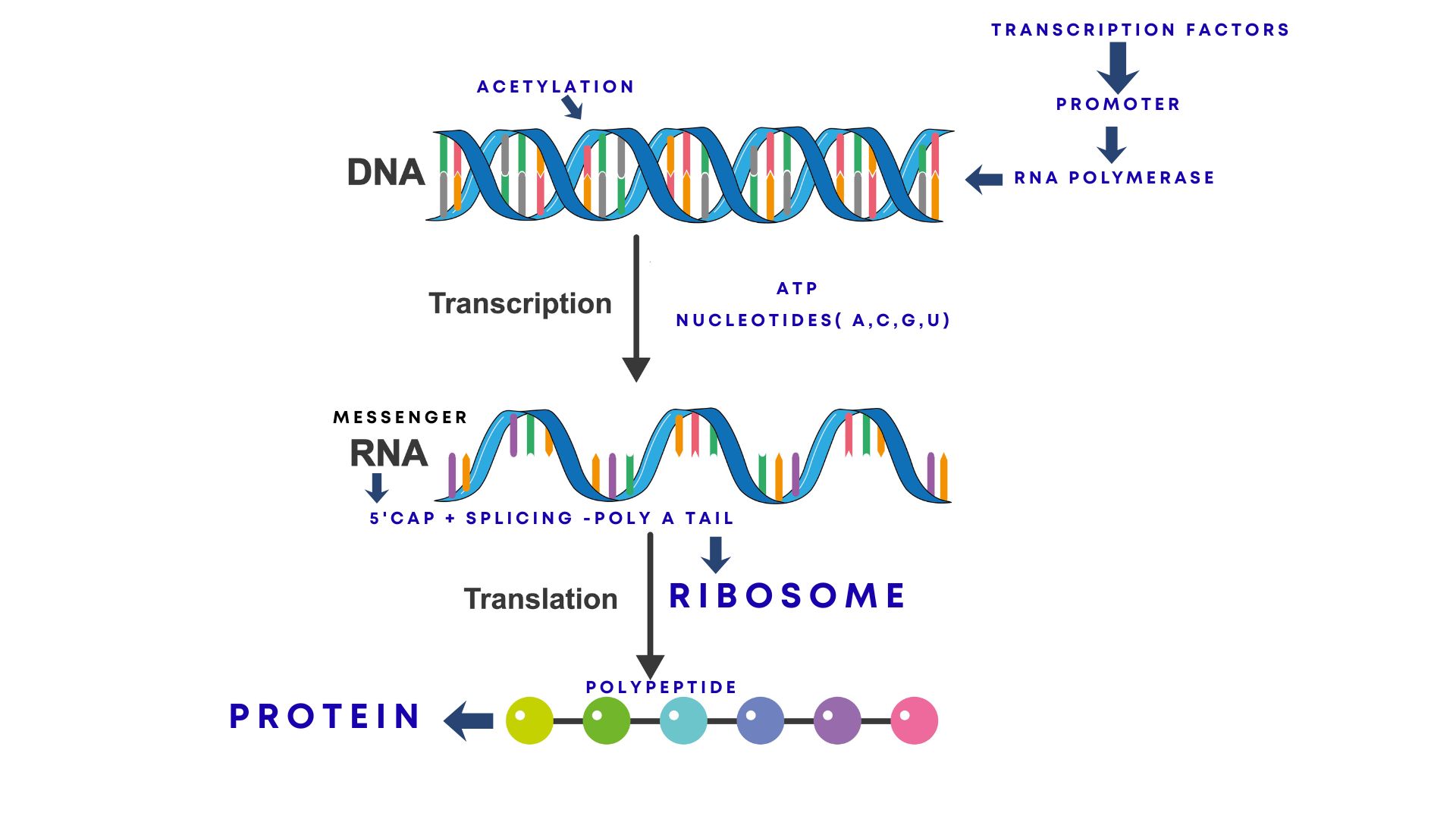
A Comprehensive Journey Through the Central Dogma
The Central Dogma of Molecular Biology is the grand narrative of biological information. First proposed by Francis Crick in 1958 and refined in 1970, it describes how the digital instructions of inheritance are translated into the analogue reality of living organisms (Crick, 1958). Far from a rigid, one-way pipeline, the modern interpretation of the Dogma reveals a sophisticated system of feedback loops, quality control, and environmental integration that allows life to remain both stable and adaptive.
I. The Vault: DNA and the Preservation of Information
At the foundation of this system lies Deoxyribonucleic acid (DNA). DNA serves as the biological "hard drive," a high-security vault that stores the complete blueprints for an organism. In eukaryotic cells, this vault is the nucleus, where DNA is packaged into a double-stranded helix stabilised by complementary base pairing. This structure is not merely for compact storage; it provides the durability necessary for genetic information to be transmitted across generations (Alberts et al., 2022).
However, the "vault" is not static. Through Replication, DNA provides a template for its own duplication, ensuring that, when a cell divides, the information is perpetuated. While the code is incredibly stable, it remains responsive to the "director" of the cell: Epigenetics. Through mechanisms such as DNA methylation and histone modification, the cell can "lock" or "unlock" specific regions of the DNA blueprint without altering the underlying sequence (Allis & Jenuwein, 2016). As Denis Noble (2006) argues, DNA does not act in isolation; it is a template that requires a cellular context to be meaningful.
II. The Messenger: Transcription and the Special Transfers
To use the instructions in the vault, they must be converted to a mobile format. This is Transcription, where the enzyme RNA polymerase reads a DNA segment and synthesises a complementary Messenger RNA (mRNA) molecule.
The Quality Control Gate
Before mRNA can leave the safety of the nucleus, it undergoes rigorous editing. During the process, a 5′ cap and a poly-A tail are added alongside Alternative Splicing—a process in which different sections of the RNA (introns) are removed, and others (exons) are joined. This allows a single gene to produce multiple protein variants, vastly increasing the organism's complexity without requiring more DNA. Vigilant surveillance mechanisms, such as nonsense-mediated decay, ensure that only "clean" messages reach the cytoplasm (Alberts et al., 2022).
Exceptions
While the general flow is DNA to RNA, biology has evolved "Special Transfers" that challenge the original linear model:
- Reverse Transcription (RNA to DNA): Discovered by Temin and Baltimore in 1970, some viruses use reverse transcriptase to transcribe their RNA into the host's DNA. This "Teminism" proves that information can flow backwards from RNA to the vault (Temin & Mizutani, 1970; Baltimore, 1970).
- RNA Replication (RNA to RNA): Many viruses bypass DNA entirely and replicate their genetic material directly from RNA templates.
III. The Factory: Translation and Protein Synthesis
Once the mRNA reaches the cytoplasm, it arrives at the Ribosome, the site of Translation. Here, the digital code of four nucleotides is translated into the analogue language of twenty amino acids. The Ribosome reads the mRNA in triplets called Codons. Transfer RNA (tRNA) molecules act as the bilingual translators, matching specific amino acids to each codon (Watson et al., 2014).The Critical Fold
However, protein folding is a critically sensitive stage of gene expression. Misfolded proteins cause problems leading to cellular "pollution," contributing to neurodegenerative diseases like Alzheimer's (Pohl & Dikic, 2019). However, the transition from a linear sequence to a 3D structure is biochemically challenging. Spontaneous misfolding can occur due to environmental stressors (such as heat or pH changes), necessitating a robust protein quality control (PQC) network to maintain cellular homeostasis. To combat the buildup of misfolded, nonfunctional proteins, cells employ "cleanup crews"—chaperone proteins that assist folding — and the Proteasome, which recycles misfolded proteins through ubiquitination.IV. The Impossible Barrier: Why Protein is the Dead End
The most striking rule of the Central Dogma is the "Unknown Transfers": Protein to DNA, Protein to RNA, and Protein to Protein. These are considered naturally impossible (Crick, 1970).
The barrier is thermodynamic and informational. While we have a "key" to turn nucleotides into amino acids, no biological machinery exists to "read" a 3D folded protein and reverse-engineer it into a 1D genetic sequence. Furthermore, because the genetic code is considered degenerate as a result of multiple codons coding for the same amino acid, once Translation is complete, the original DNA combination is practically lost. Even Prions, which transfer folding shapes between proteins, do not transfer the underlying genetic sequence, thus preserving Crick's core rule. Once information is processed and the protein is folded, the original script cannot be retrieved.V. Conclusion: A Systems-Level Symphony
The Central Dogma reveals that life is not a top-down dictatorship ruled by DNA, but a coordinated system of relationships. DNA stores, RNA communicates, and proteins execute—all while being modulated by epigenetic "volume knobs" and environmental signals.
By viewing the Dogma through this lens—combining the logic of molecular biology with the narrative of cellular "vaults" and "cleanup crews"—we see a framework that is both a masterpiece of engineering and a testament to biological resilience. As we move further into the age of gene editing, understanding these boundaries and flows is not just academic; it is the key to mastering the language of life itself (Noble, 2017).
References
“
- Alberts, B., Heald, R., Johnson, A., Morgan, D., Raff, M., Roberts, K., & Walter, P. (2022). Molecular biology of the cell: seventh international student edition with registration card. WW Norton & Company.
- Allis, C. D., & Jenuwein, T. (2016). The molecular hallmarks of epigenetic control. Nature reviews genetics, 17(8), 487-500.
- Anfinsen, C. B. (1973). Principles that govern the folding of protein chains. Science, 181(4096), 223-230.
- Baltimore, D. (2010). RNA-dependent DNA polymerase in virions. A century of Nature: twenty-one discoveries that changed science and the world, 173.
- Crick, F. H. (1958, January). On protein synthesis. In Symp soc exp biol (Vol. 12, No. 138-63, p. 8).
- Crick, F. (1970). Central dogma of molecular biology. Nature, 227(5258), 561-563.
- Noble, D. (2008). The music of life: biology beyond genes. Oxford University Press.
- Noble, D. (2017). Dance to the tune of life: Biological relativity. Cambridge University Press.
- Pohl, C., & Dikic, I. (2019). Cellular quality control by the ubiquitin-proteasome system and autophagy. Science, 366(6467), 818-822.
- Temin, H. M., & Mizutani, S. (1998). RNA-dependent DNA polymerase in virions of Rous sarcoma virus (Reprinted from Nature vol 226, pg 1211-1213, 1970). Reviews in Medical Virology, 8(1), 6-8.
- Watson, J. D. (1970). Molecular biology of the gene.